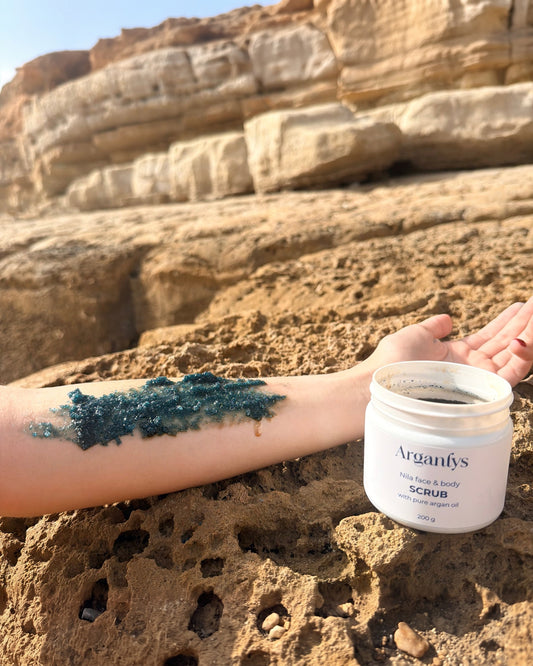
Walk through any souk in Marrakech or Fès and you will see it: small balls and heaps of intense blue powder sold next to henna, ghassoul and savon beldi. This is nila, the Moroccan blue that grandmothers, hammam attendants and brides have trusted for generations. Here is what it actually is, where it comes from and how to use it without being fooled by a fake.
What nila actually is
Nila (النيلة) is the Moroccan name for a natural blue pigment made from the leaves of indigo plants, mainly species of Indigofera. The leaves are soaked and fermented, the blue sediment is collected, then dried and pressed into powder or small blocks.
In Morocco you will hear it called nila zarqa (blue nila) or nila beldia (traditional, "of the country" nila). In French it is often sold as poudre de nila or indigo marocain. It is the same family of plant that has dyed fabric blue across Africa and Asia for centuries.
In skincare, nila is valued as part of a brightening ritual. Used with exfoliation and nourishing oils, it is traditionally associated with a fresher, more even-looking complexion. It does not change your natural skin colour, and it should never be sold to you as if it does.
Where Moroccan blue comes from: Saharan and bridal roots
The "blue people" of the desert
The best-known image of nila comes from the Sahara. Desert communities, often called the "blue people", wore veils and robes dyed deep indigo. Over time the dye transferred onto their skin, leaving a faint blue tint that became part of their identity.
That indigo-tinted cloth travelled along the old caravan routes into southern Morocco, through towns like Guelmim and Tan-Tan, and into city souks. With it came the belief that indigo was good for the skin.
Nila in the Moroccan bride's week
In many Moroccan families, nila is closely tied to marriage. In the days before the wedding, a bride may follow a full hammam ritual: savon beldi, a vigorous kessa, a nila mask, and sometimes nights spent in a nila-tinted pyjama. The aim is to arrive at the hanna night and the wedding with skin that feels smooth and looks luminous.
As our grandmothers say at the hammam, beauty is not bought in one visit; it is built, week after week, with patience and a good kessa.
That saying captures something true: nila on its own is not magic. It works as part of a patient ritual of cleansing, exfoliating and nourishing.
Real nila vs fake nila in the souk
Because nila is popular, the souks also sell many blue powders that are not authentic. Some are synthetic dyes, and some are the laundry bluing powder traditionally used to brighten white clothes. These were never meant for skin.
Signs you may be looking at a fake
- It stains hard. Synthetic blue can leave stubborn blue patches on skin, nails and towels that do not rinse away after a normal hammam.
- The colour is too bright or too uniform. Plant indigo tends to look deep, slightly uneven and a little matte rather than electric blue.
- It smells chemical. Authentic nila has an earthy, slightly fermented smell. A sharp or perfumed smell is a warning sign.
- The price is suspiciously low and the seller cannot tell you where it came from.
- It irritates quickly. Stinging, burning or redness are reasons to stop immediately.
Patch test first: Even authentic nila can disagree with some skin. Apply a small amount inside your forearm and wait 24 hours before using it on larger areas. If you have eczema, broken skin, active cystic acne or are pregnant, ask a dermatologist before starting a nila ritual.
A good rule: if you cannot trace where a nila comes from, do not put it on your face. Choose a product with a clear ingredient list that names the plant source, for example Indigofera tinctoria or Indigofera suffruticosa extract.
How to use nila in a gentle routine
Traditionally, nila is never used alone. It sits inside a sequence, and the order matters more than the amount. A simple weekly version looks like this:
- Steam and soften. A hot shower or hammam for 10 minutes to open the skin up and loosen dead cells.
- Cleanse with black soap. Spread a nila soap on damp skin, leave it 3-5 minutes, then rinse.
- Kessa. Rub with a kessa glove in firm, long strokes to lift away dull, dead skin.
- Mask or scrub. Apply a nila mask for 7–10 minutes, or massage in a nila scrub on rough areas.
- Nourish. Finish with a few drops of argan oil while the skin is still slightly damp.
We go through each step in detail in our guide to doing a Moroccan hammam at home, and the soap step is covered in our savon beldi guide.
Tip: A faint blue trace after a nila mask is normal with authentic indigo and usually disappears with your next rinse or kessa. Use an old towel the first few times, just in case.
Under the Moroccan sun
If you are using nila because of dark marks or an uneven-looking tone, daily SPF is not optional. Moroccan sun, especially in summer in Marrakech or Agadir, can undo weeks of careful exfoliation. Use a broad-spectrum sunscreen on any exposed area every morning.
How Arganlys uses nila
We wanted to keep the ritual our mothers knew, without the guesswork of the souk. Every nila product in our range lists its plant source on the label, and each one is built for a specific step of the hammam.
- Brightening Nila Soap: Moroccan black soap made from olive oil, with authentic Indigofera extract. Your cleansing step.
- Nila & Argan Brightening Scrub: Indigofera suffruticosa extract with argan oil, sweet almond oil and honey, for rough texture, strawberry legs and marks on the body.
- Nila & Argan Brightening Mask: Indigofera tinctoria extract with argan oil, glycerin and honey, applied after exfoliation.
- Nila Bridal Brightening Pyjama: the original Tiger brand (نمر), worn for the traditional pre-wedding nights.
Our stance is simple: your skin does not need to be bleached. It needs a consistent routine that cleanses, exfoliates and nourishes it gently. Nila is one beautiful part of that routine, not a shortcut.
What to expect, honestly
Nila works through regularity. Most people notice skin that feels smoother after the first few sessions, thanks to the kessa and the oils. A more even-looking tone and softer-looking marks take consistent weekly use over several weeks, plus sun protection. Anyone promising overnight "whitening" is selling something you should avoid.
Shop the ritual
Nila & Argan Brightening Bundle — the soap, scrub and mask together, so every step of your weekly nila ritual is covered.
Frequently asked questions
Does nila whiten or bleach the skin?
No. Authentic nila does not change your natural skin colour, and any product promising to whiten or bleach should be avoided. Used in a routine with black soap, kessa and argan oil, it is traditionally used for a brighter, more even-looking complexion. Pair it with daily SPF if dark marks are your concern.
How can I tell if nila from the souk is real?
Authentic plant nila has an earthy smell, a deep slightly uneven blue and rinses away within a wash or two. Synthetic dye or laundry bluing often looks electric blue, smells chemical and stains skin and towels stubbornly. If the seller cannot tell you the source, choose a product that lists Indigofera extract on its label instead.
Can I use nila on my face?
Yes, if it is an authentic, skin-safe nila product and you patch test it first. Apply a mask like the Nila & Argan Brightening Mask for 7–10 minutes after gentle exfoliation, then remove with a damp cotton pad. Skip it on broken or irritated skin and see a dermatologist for melasma or cystic acne.
Why does nila leave a blue tint?
Indigo is a natural dye, so a faint blue trace can remain after a mask or scrub. It usually fades with your next rinse or kessa session. A tint that does not wash out after a hammam is a sign the powder may be synthetic.